The Early Microbial Protein Development Decisions That Can Cost You Later
KBI Biopharma | August 2026
In biopharmaceutical manufacturing, every molecule presents a unique set of development priorities. As a result, developers must navigate a unique combination of scientific uncertainty, financial constraints, and commercial objectives, requiring decisions that can shape not only the timeline to first-in-human studies, but also the long-term viability of the manufacturing process itself.
The challenge is that these priorities rarely align; accelerating development may require accepting greater technical risk, while exhaustive optimization can delay critical milestones and consume limited resources before a program's feasibility is established. At the same time, choices made during the earliest stages of development, from strain selection and media formulation to process screening and purification strategy, can have lasting implications for scalability, process robustness, and cost of goods. What appears to save time today may ultimately require substantial redevelopment as a molecule progresses toward clinical manufacturing.
As recombinant proteins continue to expand into increasingly diverse therapeutic applications, developers are moving away from rigid, one-size-fits-all workflows in favor of more adaptive development strategies. Rather than applying the same level of optimization to every program, successful organizations are aligning technical decisions with the specific priorities of each asset, balancing speed, cost, and process performance according to the needs of the molecule, the stage of development, and the realities of available funding.
This shift demands development platforms capable of generating meaningful process knowledge from the earliest experiments while preserving a clear path to scale-up. High-throughput automation, platform technologies, and accumulated process expertise each contribute to this objective, but their greatest value lies in how they are combined to support informed, phase-appropriate decision making rather than simply accelerating individual experiments.
Every Development Program Has a Different Definition of Success
Often when discussing phase-appropriate development, stakeholders tend to take a linear view, one that sees Phase 1-versus-Phase 2 or Phase 2-versus-Phase 3 as singular and self-contained checkpoints on the road to commercial success. Yet reaching the completion of any development phase is rarely a single milestone. Instead, it reflects the accumulation of numerous interconnected activities, many of which influence one another. Moreover, early-stage decisions can have a greater impact on later development than organizations focused on reaching the clinic can initially recognize.
This equation is complicated further in biopharmaceutical development, where every molecule introduces a distinct combination of technical challenges, manufacturing considerations, and commercial objectives. No two microbial protein development programs begin under the same conditions. While recombinant expression in microbial hosts has become increasingly standardized through advances in molecular biology, automation, and process development, the strategic objectives guiding each program remain remarkably diverse. A biotechnology startup advancing its first therapeutic candidate operates under a different set of constraints than an established pharmaceutical company expanding an existing pipeline. Similarly, a program targeting a rare disease with expedited regulatory pathways demands a different development strategy than a biosimilar or commercially manufactured reagent where production economics ultimately determines market viability.
These differences extend well beyond scientific considerations. Funding strategy, competitive positioning, intellectual property timelines, anticipated manufacturing scale, and target product profiles all influence what defines a successful development program. For one organization, success may mean producing sufficient material to generate proof-of-concept data before the next financing milestone; for another, it may mean establishing a robust manufacturing process capable of supporting global commercial demand years before launch. The optimal development strategy is rarely universal because the risks worth solving early vary from one program to the next.
Despite these differences, many development workflows continue to follow a largely standardized path. Process optimization often proceeds according to predetermined packages or fixed development plans, regardless of whether every experiment meaningfully advances a program's immediate objectives. While comprehensive characterization has undeniable value, pursuing exhaustive optimization too early can consume valuable time and resources before critical questions about a molecule's viability have been answered. Conversely, minimizing early development to accelerate timelines may allow technical challenges to remain hidden until scaleup, when they become significantly more difficult and more expensive to resolve.
The challenge is not choosing between speed and rigor but rather determining where each delivers the greatest value. Early development should generate the knowledge needed to make confident technical and business decisions while avoiding unnecessary work that fails to improve future outcomes. However, doing so requires recognizing that different programs demand different balances of speed, investment, and process understanding throughout development.
The competing priorities accompanying these decisions typically converge around three fundamental drivers: development timeline, available resources, and long-term process performance. Accelerating one often influences others, as moving faster may require narrowing experimental scope or accepting greater uncertainty, while deeper optimization can improve process robustness at the expense of additional time and investment. The most effective development strategies, therefore, acknowledge these tradeoffs from the outset, tailoring technical decisions to the realities of each program rather than forcing every molecule through the same development pathway.
Balancing the Three Drivers of Early Development
If every development program is shaped by the same three forces, the challenge is not deciding which of these matters most in general, but in determining which should take precedence at a particular stage of development. An early-stage biotechnology company racing toward proof of concept will inevitably make different decisions than an organization developing a biosimilar or preparing for commercial manufacturing. The most successful programs recognize these priorities as dynamic rather than fixed, adjusting development strategies as technical understanding and business objectives evolve.
Rather than treating these objectives as competing priorities, KBI Biopharma approaches them as interconnected variables that should be balanced according to each program's unique priorities. Some clients require accelerated timelines without fundamentally changing development scope; others prioritize efficient use of limited capital during proof-of-concept studies while still others seek the deepest possible optimization to maximize yield and minimize manufacturing costs. Instead of prescribing a single development pathway, KBI's framework is designed to flex around these differing objectives, allowing technical strategy to evolve alongside the program itself.
While the scientific principles underlying microbial protein development remain consistent, the development strategy itself should reflect the goals of the organization behind the molecule. A program's competitive landscape, funding model, technical complexity, and commercial objectives all influence where development resources deliver the greatest return.
For organizations where speed represents the highest priority, compressing timelines often means identifying opportunities for parallel execution rather than reducing scientific rigor. Accelerated workflows can shorten development by deploying additional resources, conducting activities at risk where appropriate, and integrating rapid analytical methods alongside standard characterization. Instead of eliminating critical experiments, the emphasis shifts toward removing idle time between them. KBI's accelerated service offerings are built around this principle, enabling significant reductions in development timelines while maintaining comparable technical scope.
Other programs operate under a different set of constraints. Emerging biotechnology companies frequently progress through milestone-based financing, making efficient capital allocation essential. Under these circumstances, early development must establish technical feasibility without committing resources to optimization that may not yet be justified. KBI addresses this challenge by combining automated screening workflows with flexible project structures that align development activities with key funding milestones. Platform technologies that are available without licensing fees through proof-of-concept and toxicology studies further extend available resources, allowing organizations to establish scalable process foundations before making larger long-term investments.
For other developers, long-term manufacturing performance becomes the primary measure of success. Commercial biologics, biosimilars, and GMP reagents often require exceptionally robust processes capable of delivering high yields, consistent product quality, and competitive manufacturing economics. Achieving these outcomes frequently demands more extensive optimization, broader experimental designs, and deeper characterization than programs focused primarily on reaching early clinical milestones. High-throughput screening makes this level of optimization increasingly practical, enabling developers to evaluate significantly larger experimental spaces without proportional increases in cost or timeline.
KBI's flexible development framework accommodates each of these priorities by adjusting the depth of screening, level of optimization, and application of platform technologies according to program needs. Rather than viewing speed, cost, and process quality as mutually exclusive objectives, the approach recognizes that each program requires a different balance. By tailoring development strategy to business and technical priorities, organizations can invest effort where it generates the greatest long-term value while avoiding unnecessary complexity during earlier stages of development.
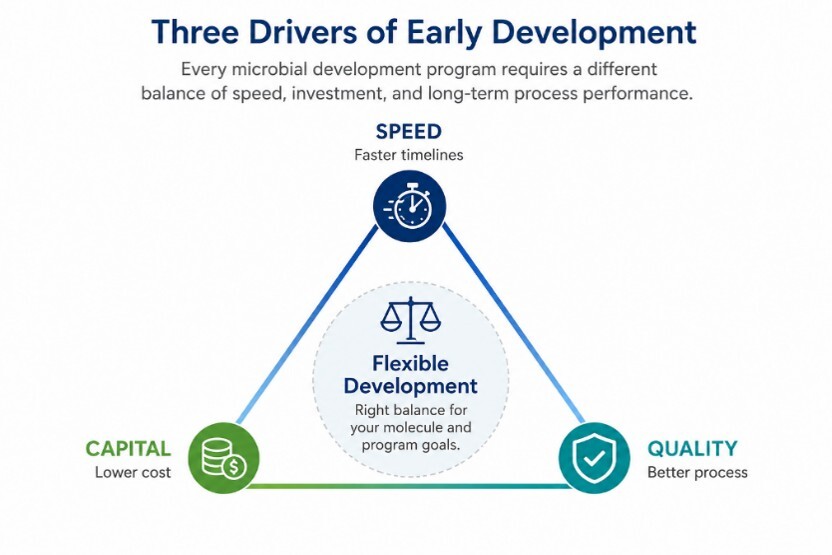
IMAGE: Every microbial development program requires a different balance of speed, investment, and long-term process performance.
Business Impact: Flexible Development Creates Better Business Outcomes
While microbial protein development begins with scientific decisions, the downstream impact extends far beyond the laboratory. An early development strategy aligned with business priorities can help organizations:
- Reach critical development milestones faster
- Allocate limited R&D funding more efficiently
- Reduce costly redevelopment during scale-up
- Improve technology transfer into GMP manufacturing
- Build manufacturing processes that support long-term commercial success
Rather than viewing speed, cost, and process quality as competing priorities, organizations that align technical strategy with business objectives are often better positioned to reduce risk while accelerating development.
The Technologies That Enable Flexible Development
Automation, platform technologies, and accumulated process expertise each contribute unique strengths, but their greatest impact is realized when they operate as an integrated development framework rather than independent capabilities. Automation has fundamentally changed the scale at which process development can be performed. Robotic liquid handling, miniature fermentation systems, and automated analytical workflows allow hundreds of experimental conditions to be evaluated with a level of consistency that would be difficult to achieve through manual experimentation alone. Beyond increasing throughput, automation enables broader exploration of design space while generating datasets that support statistically informed decision-making.
Flexible development depends on more than adaptable project plans; it requires technologies capable of supporting informed technical decisions at every stage of a program. KBI incorporates robotic workflows throughout cell line development and process optimization, allowing deeper experimental screening without proportional increases in development cost or timeline.
Complementing these automated workflows are KBI's proprietary platform technologies, including the PureColi®, PureMedia®, and PurePlasmids™ offerings. Rather than requiring every development program to begin with first principles, these technologies provide validated starting points built upon extensive historical experience. Engineered microbial strains, optimized expression constructs, and standardized media formulations reduce experimental uncertainty while preserving the flexibility needed to address molecule-specific challenges. According to KBI's development experience, these platform technologies have consistently improved expression performance and reduced process impurities, providing stronger starting conditions for subsequent optimization.
Technology alone, however, cannot replace experience. Process development remains fundamentally an exercise in informed decision-making, requiring an understanding of which variables warrant extensive investigation and which can be guided by historical knowledge. KBI integrates decades of microbial process development experience with sequence-informed assessments, protein biophysics, and established scaling strategies to prioritize experimentation where it is most likely to improve outcomes. This experience-driven approach focuses optimization on the parameters that have the greatest influence on yield, product quality, and manufacturability while reducing unnecessary experimentation.
Conclusion
No two microbial protein development programs begin with the same technical, financial, or commercial objectives. Consequently, development strategies should be as adaptable as the molecules themselves.
Organizations that align early scientific decisions with long-term business goals are better positioned to accelerate timelines, manage development costs, and build scalable manufacturing processes capable of supporting future clinical and commercial success.
By combining automation, platform technologies, and decades of microbial development expertise, KBI Biopharma helps clients build development strategies that evolve alongside their programs—providing the flexibility to prioritize speed, capital efficiency, or manufacturing robustness as program needs change.
Whether advancing a first-in-human therapeutic, optimizing a biosimilar, or preparing a commercial manufacturing process, the most successful programs begin with one fundamental principle:
The best development strategy is not the same for every molecule; it is the one designed for your molecule.
Questions to Ask Your Microbial Development Partner
Choosing a microbial development partner involves more than evaluating technical capabilities. Consider asking questions such as:
- How do you tailor development strategies for different molecules rather than following a standard workflow?
- Which platform technologies can accelerate development without sacrificing scalability?
- How do you balance rapid timelines with long-term manufacturing robustness?
- What automation capabilities are available to improve screening efficiency?
- How do you reduce redevelopment risk during technology transfer?
- Can development activities be aligned with funding or clinical milestones?
- How do you determine the appropriate level of optimization for my program?
These conversations often reveal whether a CDMO is simply executing experiments or helping develop the right strategy for the molecule.
Every microbial development program presents unique technical and business challenges.
If you're evaluating expression strategies, optimizing an existing process, or preparing for scale-up, KBI's microbial development experts can help identify the development approach best suited to your molecule and your program objectives.
Explore KBI's flexible microbial development capabilities or connect with one of our scientific experts to discuss the strategy best suited for your molecule.
KBI Biopharma is a biologics-focused CDMO with a heritage in analytical sciences. KBI offers integrated analytical, formulation, and manufacturing services from early development through commercial supply reducing risk for biopharmaceutical developers.

 KBI Biopharma
 KBI Biopharma : Nov 11, 2022, 9:46:44 AM