Three Emerging Trends From San Diego Worth Watching
KBI Biopharma | June 2026
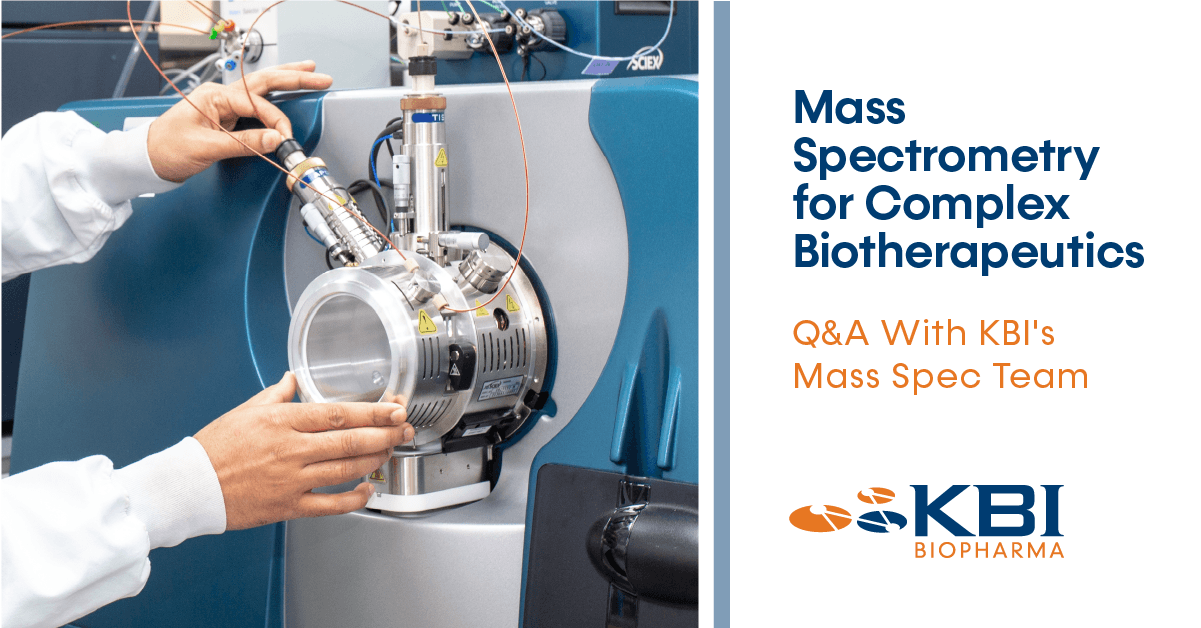
Select researchers from the KBI Biopharma Mass Spectrometry team spent the week at the 74th Annual American Society for Mass Spectrometry Conference (ASMS) in San Diego alongside more than 6,000 scientists and industry professionals. ASMS draws from across the scientific spectrum, academic research, early discovery, and regulated development, and not every technology discussed is ready for the regulatory and compliance-intensive environment CDMOs operate in. But some of what was presented this year signals where the field is heading and which capabilities development teams should be thinking about now, before the expectation arrives.
Emerging Trend 1: Charge Detection Mass Spectrometry (CDMS) may redefine characterization for large molecules and complex modalities
While CDMS instrumentation has been used in the research space for many years, it has not been widely adopted commercially. Widespread adoption in regulated development settings is still ahead, however, the Waters® Xevo™ CDMS drew sustained attention across sessions and the exhibit floor.
-
AAV vectors, lipid nanoparticles, and large protein assemblies have been the hardest molecules to characterize reliably. CDMS is designed to address that gap directly
-
CDMS provides individual-particle measurement, no digestion required, and results in under ten minutes
-
Scientists from gene therapy and AAV programs were asking fit-for-purpose questions, signaling that interest is moving beyond the research bench
-
Regulatory precedent for CDMS in development and manufacturing does not yet exist. But the industry is clearly building toward it, and the timeline to implement is likely shorter than many expect
Emerging Trend 2: Ion mobility is following a similar path
Ion mobility appeared across biotherapeutic characterization, glycan analysis, and intact protein sessions at ASMS 2026, not just in structural biology. Its presence is broadening, but routine deployment in regulated development settings remains a future state.
-
Ion mobility adds what conventional MS cannot: conformational data and resolution for molecules that differ in three-dimensional structure rather than mass alone
-
The regulatory questions around higher-order structure characterization are already being asked. The tools to answer them are maturing ahead of the formal expectation
-
High-resolution MS predated its regulatory expectation by nearly a decade. Ion mobility appears to be on a comparable trajectory
-
Development teams working on conformationally sensitive molecules, complex modalities, or biosimilar comparability packages have reason to follow this space now
-
The challenge of space in a regulated lab for an ion mobility equipped instrument remains with a footprint of about 7-8.5 ft even with Structures for Lossless Ion Manipulation (SLIM) technology.
Emerging Trend 3: AI for mass spectrometry data interpretation is outpacing the readiness of most labs
The 2026 ASMS corporate member list included a striking number of AI and data intelligence companies that had little or no presence at this conference five years ago. This is an early signal, not a mature market, but the direction is clear.
-
Companies like Matterworks have built foundation AI models trained on mass spectra, designed to extract biological insight from raw LC-MS data without manual processing
-
Protein Metrics, Science Machine, Fragmatics, Bioinformatics Solutions, and GeneData represent a category that is expanding rapidly on the exhibit floor
-
The bottleneck in many programs is shifting from data generation to data interpretation. These tools are being built to close that gap
-
Deploying AI tools in a regulated environment will require validation, method qualification, privacy considerations, and human oversight that the industry is only beginning to define. But the underlying capability is real and the investment behind it is accelerating
Final Observation
None of these trends are fully realized in regulated development today. But each one is moving in a consistent direction: larger molecules, more powerful instruments, and smarter infrastructure for turning data into decisions. The organizations that begin building familiarity with these capabilities now, before regulatory expectations and client demand catch up, will be better positioned than those who wait until the expectation is already at the door.
Want to see these capabilities in practice? While the technologies at ASMS point to the future, our teams are actively solving today's most complex characterization challenges. Watch our analytical experts in action and learn how we deliver clarity for critical programs in our Peptide Mapping Insights for Drug Development.
KBI Biopharma is a biologics-focused CDMO with a heritage in analytical sciences. KBI offers integrated analytical, formulation, and manufacturing services from early development through commercial supply reducing risk for biopharmaceutical developers.
About the Author
Ready to Strengthen Your Analytical and Formulation Strategy?
For biopharmaceutical innovators evaluating complex modality characterization, planning for robust clinical formulation, or preparing comprehensive release and stability testing data for regulatory diligence, KBI Biopharma's Analytical and Formulation Sciences (AFS) team is built to help.
Our vast network of over 400 analytical scientists works with sponsors to develop customized analytical methods, statistically modeled formulations, and product characterization plans that anticipate quality challenges and remain fully aligned with rigorous regulatory guidelines. Reach out to our experts below to see how we can help you navigate through this complex process with your program.
 KBI Biopharma


 KBI Biopharma : Oct 27, 2023, 7:30:00 AM