Case Study:
The Ghost in the Gel: Tracking Down an Unexpected mAb Variant with LC-MS
By Ben Zigterman, Senior Scientist, KBI Biopharma
Summary
A clinical-stage biopharmaceutical customer transferred a therapeutic monoclonal antibody to a new CDMO and implemented process changes to enable commercial-scale production. Those changes introduced an uncharacterized product-related variant affecting 20% to 30% of total product.
After the customer and their CDMO were unable to characterize the variant using standard platform analytical methods, KBI Biopharma developed and executed a customized LC-MS-based analytical strategy to identify, structurally characterize, and establish quantitative control of the species, enabling the customer to remediate the process and continue program development, preventing late-stage failure.
The Risk Inherent in Every Tech Transfer
Over 60% of biopharmaceutical companies now outsource at least some manufacturing activities1, and that number keeps rising. More outsourcing means more technology transfers, and more technology transfers means more opportunities for unexpected impurities to be discovered in a product profile that were not previously detected.
Process modifications introduced during scale-up which are designed to improve yield or enable commercial production, can introduce product-related variants that standard platform analytical methods are not designed to detect. As BioProcess International has noted, technology transfer is "a delicate operation carrying business, regulatory, product quality, and technical risks.2" The specific challenges vary by program, but anomalous data frequently surfaces even after significant development investment has already been made.
This case documents one such scenario. Following the transfer of a therapeutic monoclonal antibody to a new CDMO and the implementation of process modifications for commercial-scale production, an uncharacterized species appeared in gel analysis of the updated material. The customer and their CDMO investigated together, but conflicting test results and the limits of available platform methods left the identity of the variant unknown. That is when the customer engaged KBI Biopharma.
Talk to Our Experts Today.
|
Case Background |
|
|
Customer |
Clinical-stage biopharmaceutical company |
|
Product |
Therapeutic monoclonal antibody (mAb) |
|
Challenge |
Uncharacterized product-related variant identified post-tech transfer; not detectable by platform assays |
|
Variant Level |
20% to 30% of total product |
|
KBI Solution |
Customized top-down LC-MS analytical strategy |
|
Outcome |
Variant identified, structurally characterized, and quantitative QC method established |
Why Standard Assays Were Not Enough
During scale-up, the customer observed an unfamiliar species in SDS-PAGE analysis of the updated process material. As shown in Figure 1, it presented as a faint, higher-molecular-mass band co-migrating with the heavy chain, subtle but reproducible.
The customer and their CDMO investigated the finding together using process qualification assays, including capillary isoelectric focusing (cIEF), size exclusion chromatography (SEC), and a peptide-mapping identity and multi-attribute method (MAM/ID). All returned no signal. TOF mass spectrometry eventually confirmed the existence of the variant, revealing a second species with a 2,518-Da mass shift relative to the intended form. However, the TOF data neither identified the species nor explained why it had evaded peptide mapping. With conflicting results and a pressing development timeline, the customer engaged KBI Biopharma.
The core challenge was methodological. Standard peptide mapping is designed to identify expected species and is not well suited to detecting unknown variants. Identifying this species required a customized analytical approach built around the specific characteristics of the unknown.
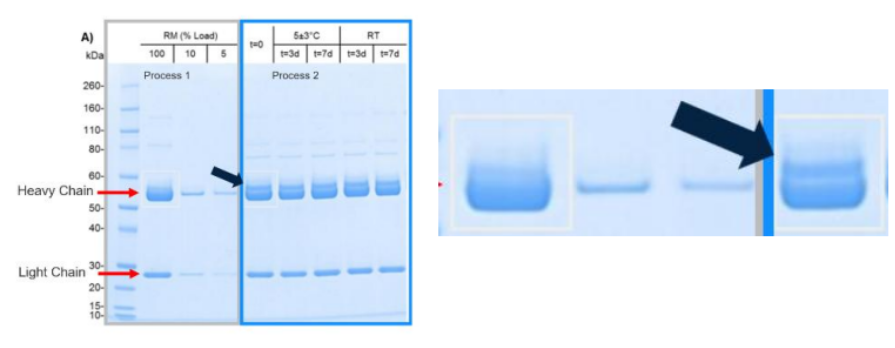
Fig. 1 — SDS-PAGE analysis comparing process 1 materials (small scale, from CDMO A) to process 2 materials (large scale, from CDMO B) The faint upper band on the right indicates the presence of an additional, higher-mass species co=migrating with the heavy chain.
The KBI Biopharma Approach
KBI Biopharma developed a top-down, stepwise LC-MS strategy beginning with intact protein analysis to confirm the signal, followed by subunit characterization to localize and isolate the modification, and concluding with de novo peptide sequencing to determine the identity of the unknown species.
-
Step 1: Confirm the Signal Is Real
Before proceeding with a customized characterization strategy, the existing data were validated. While SDS-PAGE had flagged the variant (Fig. 1), SDS-PAGE is susceptible to imaging artifacts and lacks the molecular resolution needed for definitive characterization. Intact mass analysis using TOF mass spectrometry confirmed the 2,518-Da mass shift between the intended species and the variant, establishing a reproducible baseline for the investigation.
At this stage, multiple explanations remained viable. The mass shift did not align cleanly with N-glycan species typically observed in CHO-derived products, though a sequence variant combined with glycosylation could not be ruled out. In such a scenario, no observable shift would be expected using cIEF or SEC, which is consistent with the negative results from those assays. O-glycosylation was considered but deemed less likely given the magnitude of the shift. Incomplete signal peptide cleavage was also evaluated: signal peptide sequences provided by the customer were screened, and while some masses were similar, none aligned precisely with the observed species. A frameshift mutation was considered as well, though mass data alone was insufficient to confirm or exclude it.
-
Step 2: Localize and Isolate the Modification
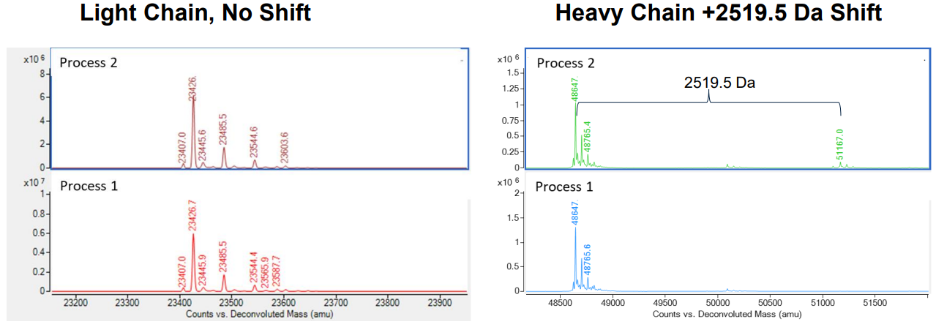
Disulfide reduction was applied to determine whether the modification resided on the light chain or heavy chain. As shown in Figure 2, the light chain showed no mass shift, while the heavy chain showed the full 2,520-Da shift following reduction, indicating that the unknown species contained cysteine residues engaged in disulfide bond formation. This behavior is inconsistent with glycan modification and is more consistent with an additional peptide sequence.
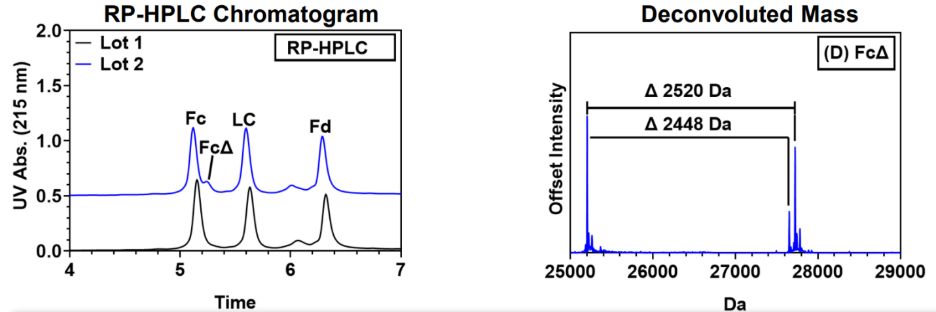
Subunit analysis was then performed using IdeS proteolysis followed by reverse phase HPLC. IdeS cleaves the heavy chain below the hinge into Fc and above the hinge into Fd, allowing variant species to be resolved chromatographically. As shown in Figure 3, a new species, designated FcΔ, separated from the standard Fc fraction. Deconvoluted mass spectra of the FcΔ peak revealed two discrete species: one with the expected 2,520-Da shift and a second at 2,448 Da. The 71-Da mass difference between them corresponds to the residue mass of alanine, consistent with a short peptide extension.
This analysis localized the modification to the Fc region, enabling isolation of the material at tens to hundreds of micrograms. Following isolation, both the Fc and FcΔ fractions were re-analyzed using RP-HPLC to confirm enrichment. The FcΔ fraction was highly enriched in the variant species, making peptide mapping analysis feasible. Prior peptide mapping attempts on bulk, unenriched material had not detected the variant, as its relative abundance was insufficient for detection under those conditions.
Fig. 2 — Disulfide reduction localizes the mass shift to the heavy chain, consistent with an additional peptide containing cysteine residues involved in disulfide bond formation.
Fig. 3 — IdeS subunit analysis resolves the FcΔ species chromatographically from the standard Fc fraction, enabling isolation of material at tens to hundreds of micrograms for downstream characterization.)
-
Step 3: Sequence the Unknown Species
Peptide mapping was performed on the isolated FcΔ fraction using sequential enzymatic digestion with trypsin and Asp-N. Each digest was analyzed by reverse phase HPLC on a C18 column and characterized by high-resolution Orbitrap LC-MS. Because the unknown sequence was absent from the reference database, de novo sequencing was applied to derive a partial peptide sequence directly from the fragmentation spectra.
A UniProt search against the derived partial sequence returned no hits, excluding a contaminating protein or naturally occurring peptide variant and pointing toward either a frameshift mutation or an aberrant splicing event, both of which would generate non-canonical sequences absent from standard reference databases.
-
Step 4: Identify the Root Cause
A targeted literature review on C-terminal extensions in recombinant antibodies identified published reports describing cases in which splice donor-acceptor sites at the C-terminus of an antibody construct can recruit noncoding downstream promoter sequences, which are then incorporated into the expressed protein.
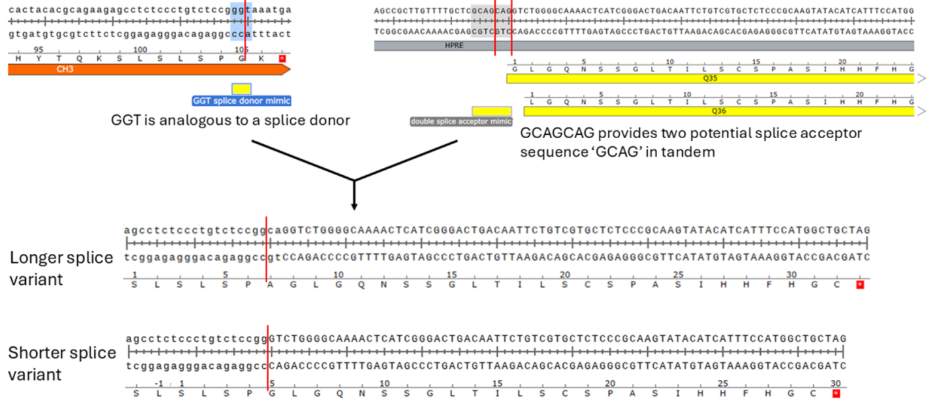
This mechanism was consistent with the analytical data. In collaboration with the customer, two candidate splicing variants were identified, designated Q35 and Q36 in Figure 4, and differentiated by the presence or absence of a single alanine residue. This distinction corresponded directly to the 71-Da mass difference identified in Step 2. Reprocessing the original tryptic digest data with the confirmed sequence verified the full C-terminal extension, confirming that the variant originated from an aberrant splicing event introduced during cell line development.
The extension included several hydrophobic residues containing cysteines, consistent with the disulfide behavior observed in Figure 2, and three histidine residues near the C-terminus. While the molecule's overall isoelectric point was unchanged under standard conditions, those histidines confer additional positive charge at low and mildly acidic pH, making the variant amenable to separation by cation exchange chromatography. A quantitative cation exchange method was subsequently developed and implemented in the customer's QC laboratory as an ongoing control strategy.
Fig. 4 — Aberrant splicing at the heavy chain C-terminus incorporates downstream promoter sequence into the expressed protein, generating two variant forms, designated Q35 and Q36, differentiated by a single alanine residue.
Results
The investigation produced a complete structural characterization of the unknown variant, including its identity, origin, and mechanism of formation, along with a validated analytical method to quantify and control it going forward. With that information in hand, the customer was able to remediate the process and continue program development.
The findings underscored the significance of the initial SDS-PAGE observation shown in Figure 1. The variant was present at 20% to 30% of total product, and given its structural profile, including hydrophobic residues, non-native cysteine-containing sequences, and a non-germline peptide, it carried meaningful immunogenicity risk. Had it gone uncharacterized, it could have progressed through late-stage clinical and regulatory activities undetected.
Understanding the root cause also informed the remediation approach. Without identifying the variant as the product of an aberrant splicing event at the cell line level, process interventions would have lacked a clear scientific basis, increasing the risk of yield loss, comparability failures, and regulatory delay.
This case illustrates a fundamental limitation of platform analytical methods: they are designed to confirm the presence or absence of expected species. Identifying unanticipated variants requires a customized methodological approach tailored to the specific analytical question at hand and expert interpretation of data.

About the Author
Ben Zigterman,
Senior Scientist, KBI Biopharma
Ben joined KBI in 2015 and holds a BS in chemistry from Colorado State University as well as 14 years of experience in protein characterization, with particular emphasis on characterization of product related impurities. At KBI, Ben uses mass spectrometry and related tools, especially peptide mapping, to determine the structure of client proteins, monitor critical quality attributes, and investigate unknown impurities.

About KBI Biopharma
KBI Biopharma is a full-service CDMO with expertise in biologics development, analytical characterization, and manufacturing. Our analytical capabilities span the full development lifecycle, from early-stage molecule assessment through commercial-scale process validation and regulatory submission support. When standard platform methodologies reach the limits of their utility, our scientific team develops customized workflows to address specific analytical challenges. To learn more about KBI Biopharma's biologics characterization capabilities, visit www.kbibiopharma.com.
Citations:
1) Kaczanowski, R. (2024). Strategies for overcoming common challenges in tech transfer. Pharmaceutical Technology, 48(11), 31–33.
2) Pora, H. (2024, January 30). Tech transfer: Unraveling the complexities. BioProcess International. https://www.bioprocessintl.com/contract-services/unraveling-the-complexities-of-technology-transfer
© 2026 KBI Biopharma