Application of Inline Variable Pathlength Technology for Rapid Determination of Dynamic Binding Capacity in Downstream Process Development of Biopharmaceuticals
Rashmi P. Bhangale, Rui Ye, Thomas B. Lindsey, Leslie S. Wolfe.
KBI's Downstream Process Development Team at our Durham, North Carolina location had their work published in the March/April 2022 issue (Volume 38, Issue 2) of Biotechnology Progress.
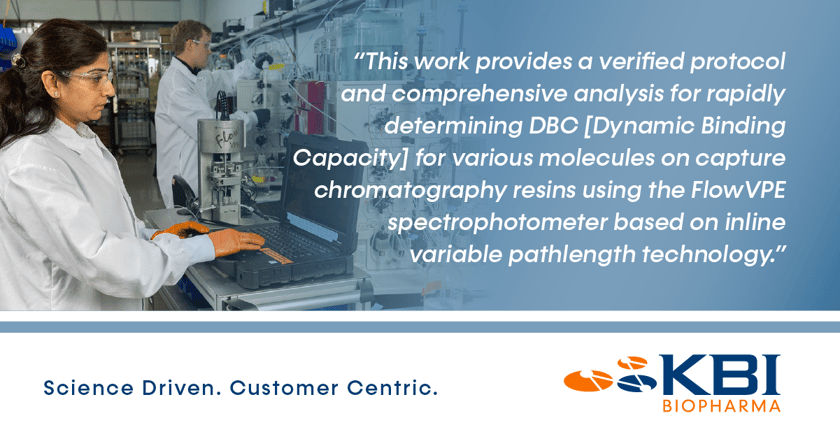
This work provides a verified protocol and comprehensive analysis for rapidly determining DBC [Dynamic Binding Capacity] for various molecules on capture chromatography resins using the FlowVPE spectrophotometer based on inline variable pathlength technology.1
Key Takeaways Include:
Investigation of inline variable pathlength technology using FlowVPE for rapid determination of DBC on affinity resins for protein capture proved comparability with offline titer methods.
Variable pathlength technology for DBC determination can be successfully applied to different classes of monoclonal antibodies and fusion proteins.
This process enabled rapid screening of affinity resins and optimization of capture chromatography.
Use of inline variable pathlength technology eliminated the dependency on offline titer data and accelerated overall process development timelines with less cost.
1. Bhangale, RP, Ye, R, Lindsey, TB, Wolfe, LS. Application of inline variable pathlength technology for rapid determination of dynamic binding capacity in downstream process development of biopharmaceuticals. Biotechnol. Prog. 2022; 38( 2):e3236. doi:10.1002/btpr.3236
 KBI Biopharma
 KBI Biopharma : Dec 8, 2023, 8:13:02 AM